DROID-SLAM
princeton-vl/DROID-SLAM加载项目详情…
本应用为开源项目,仅供学习研究,请遵守其开源协议。
加载项目详情…
本应用为开源项目,仅供学习研究,请遵守其开源协议。
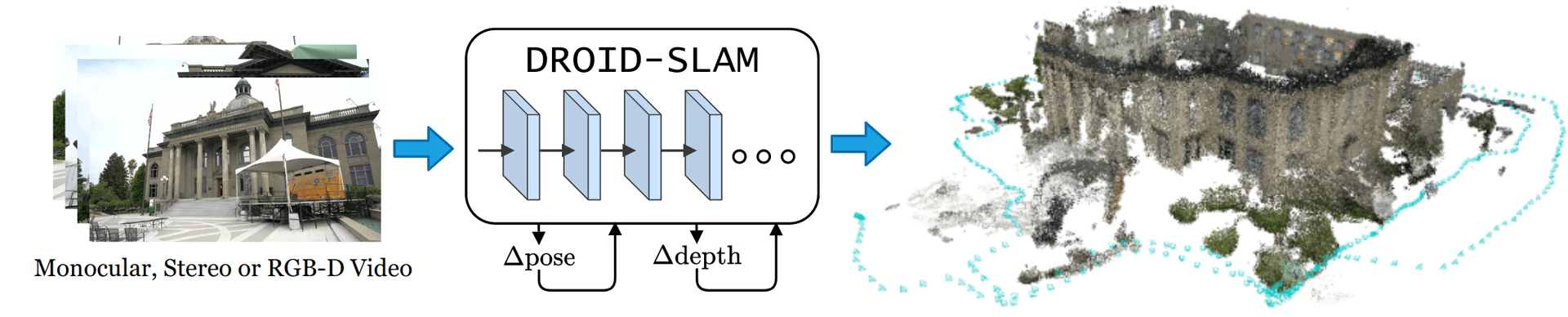
图1:DROID-SLAM 系统架构概览
Imagine walking into an unknown museum with a camera, building a mental 3D map of the entire building as you move. This is not a human talent, but it is exactly what DROID-SLAM attempts to teach machines. This research project from Princeton's Vision and Learning Lab (Princeton VL) shattered accuracy records in the visual SLAM field in 2021, with its paper cited over 3,500 times, becoming one of the most influential works in the field.
SLAM (Simultaneous Localization and Mapping) is the cornerstone of robotics and autonomous driving. Traditional SLAM systems rely on hand-crafted features like corners and edges to track camera motion. DROID-SLAM's core innovation replaces traditional hand-crafted features with a Deep Recurrent Network (Dense Bundle Adjustment layer).
The team comes from Princeton's Vision and Learning Lab. Lead author Zachary Teed studied under Professor Jia Deng (who is also a co-author of ImageNet), with a research background spanning deep geometry learning and visual navigation. After the 2021 paper publication, this work quickly became a citation benchmark for CVPR and ECCV.
DROID-SLAM's technical stack consists of three core modules:
Feature Extraction and Correlation
The network uses a pyramid convolutional encoder to extract multi-scale features, establishing pixel-level feature matching through Correlation Volume. Core code is in droid_slam/droid_net.py, with key dependencies in modules/extractor.py (basic encoder) and modules/corr.py (correlation volume).
GRU-based Iterative Update
The system uses a ConvGRU layer to implement iterative optimization. When each frame arrives, the GRU predicts optical flow residuals based on current camera pose and depth map estimates, then jointly optimizes all camera poses and pixel depths through Dense Bundle Adjustment. This step, implemented in geom/ba.py and modules/gru.py, is the core computational bottleneck.
CUDA-accelerated Dense Operations
The project includes 4 CUDA kernels in the src/ directory (droid_kernels.cu, correlation_kernels.cu, altcorr_kernel.cu, droid.cpp), compiled as GPU-accelerated operators via PyTorch C++ Extension (setup.py). This is the key to DROID-SLAM achieving real-time performance (~25-30 FPS on RTX 2080Ti).
图2:DROID-SLAM 实时重建效果
One major advantage of DROID-SLAM is its modality-agnostic input: the same codebase simultaneously supports Monocular, Stereo, and RGB-D input modes. The droid_slam/data_readers/ directory contains implementations for different camera drivers.
DROID-SLAM set accuracy records on multiple benchmarks (EuRoC, TUM-RGBD, TartanAir). Its end-to-end training paradigm profoundly influenced subsequent works like DROID-SLAM v2. It proves that replacing traditional geometric optimization with deep learning is not only feasible but can achieve state-of-the-art accuracy.
DROID-SLAM is a milestone in visual SLAM, representing the highest level of deep learning and geometric vision fusion. For robotics researchers and autonomous driving engineers, it is an excellent learning material for understanding end-to-end SLAM architecture. For industrial application developers, be prepared to invest hours in environment configuration. Its academic value far exceeds its engineering ease-of-use.